 admin
admin
Dear Partners and Friends:
2025 was another strong year for US stock markets. All the major indices we compare against rose double digits. Micro cap stocks outperformed for the first time in a while. The Russell Microcap (IWC) index rose 23.0%, even though the Russell 2000 (IWM) only rose 12.8%. The NASDAQ Composite (^IXIC) once again was the best performer of the three major indices, as it climbed 20.4%. The S&P500 (SPY (SPY)) rose 17.8% on the year. Cedar Creek was up 29.6%, net of fees and expenses, outperforming all the major indices we track. 1
While Cedar Creek Partners focuses primarily on microcap stocks, and over-the-counter stocks in particular, we compare our returns against larger indices as well since we believe we need to outperform the most prominent passive benchmarks over time in order to justify our existence.
Cedar Creek’s average annual return over our nearly 20 year history is 14.74%, net of fees and expenses, which compares favorably to all the indices we compare against. Cumulative returns since inception for Cedar Creek were 1,455.1%, net of fees and expenses.
Fund Holdings are at Incredibly Attractive Prices
On the whole, as of the end of December 2025, the fund’s holdings were trading at 7.1 times our estimate of earnings for the coming year, and 5.2 times expected earnings net of cash at the respective businesses. 2 Trailing earnings multiple was 9.6 times as of December 2025. Weighted price-to-book was 0.9. Dividend yield was 1.8% as of December 2025. Weighted expected return on equity as of December 31, 2025, was 13.0%. (note – in most of the fund’s investments, we are earnings focused and not book value or dividend yield focused.)
Cash Levels and Fund Repositioning
We started the quarter with cash levels at 17%, which was unusually high due to the sale of PharmChem in the third quarter, and ended the quarter at 13%. It is currently 7% and we have a verbal purchase agreement that will use half of it. We are still waiting on proceeds from the sale of First IC (expert: FIEB), which will move cash back to the 6-7% range. We currently want to keep roughly 5% for any redemptions and dry powder should something attractive arise. We definitely still have more ideas than cash.
Expert Market Exposure
Our exposure to stocks trading in the expert market decreased to 36% of the fund. As a reminder, expert market stocks are companies impacted by SEC Rule 15c2-11. For those unfamiliar, the rule prevents brokers from not only displaying quotes for non-reporting companies but also restricts transactions for retail customers to selling only. 3 Institutional accounts, depending on the broker, are not subject to the buying restriction.
There are a wide range of differences among “non-reporting” companies. Some are completely dark – meaning they do not communicate any financial results to shareholders (unless forced to under law). Others update quarterly or annually on their website, sometimes behind a password login. Others mail annual results out to shareholders, or just shareholders of record, but do not post them publicly.
We were forced out of our position in Propel Media (PROM) (expert: PROM) at $1.451 per share. Five positions make up about 75% of the fund’s expert market exposure – Exco Resources (EXCE) (expert: EXCO) is 8.4% of the fund, Phi Group (PHIG) (expert: PHIG) is 8% of the fund, First IC (FIEB) (expert: FIEB) is 6%, PD-Rx Pharmaceuticals (PDRX) (expert: PDRX) is 3% and Federal Life Group (FLFG) (expert: FLFG) is 2.4% of the fund.
As we noted above, we were forced out of our position in Propel Media when it agreed to be purchased by Vitruvian Partners for $1.451 per share. If you haven’t read our Q2 2023 letter that discussed how we found Propel we encourage you to. During the quarter we received the proceeds. There is a possibility of an additional payment due to some funds being held in escrow. The overall return on the investment, including dividends, during our 28 month holding period, was over 500%. We had actually expected more. (I’m sure we will find a way to live with the disappointment of only earning 500%). The deal apparently was structured to include large bonus payments to management and included adjustments related to debt and working capital that took the topline number down significantly.
As we noted in our last two letters, First IC had agreed to be acquired by MetroCity Bankshares (MCBS) (nasdaq: MCBS) for cash and stock. The deal closed in early December; however, we are still waiting on both the cash and stock proceeds. We are told the delay is due to the shares we purchased having been from certificate sellers and the matching/reconciliation process is manual. It should be completed in the next week or so. Our basis on First IC was $6.70 per share. With purchases mostly in 2023. We received two $1 per share dividends and expected proceeds are roughly $22 per share. We are very pleased with the outcome, even if the selling price of less than ten times earnings seemed a bit light to us.
During the quarter we continued to increase our position in PHI Group (expert: PHIG). As we noted above, it is nearly an 8% position. We think it is worth two to three times the most recent trading price. PHI Group is a leading provider of helicopter flight services for the global oil and gas exploration and production industry and the air medical industry. The Company emerged from bankruptcy protection in September 2019. The bankruptcy was primarily due to excessive debt rather than poor financial performance. PHI has subsequently focused on improving its margins and prioritizing a conservative balance sheet. The Company had filed an S-1 registration statement but withdrew it in May of this year. Oaktree and First Pacific Advisors each were listed as owning approximately 18% of the common shares.
Federal Life Group (expert: FLFG) announced that its 90% owned parent, which we believe is Bain, was forcing out shareholders via a short-form merger at $15.25 per share. We had been happily building a position at $9 to $9.50 per share and are disappointed that we cannot continue to do so. The company did not report publicly or privately; however, its primary subsidiary was required to report results to insurance regulators. The subsidiary was showing impressive growth and earnings while still investing heavily in the business and in a Bermuda-based reinsurer. In the first nine months of 2025 their Federal Life Insurance Co. subsidiary reported over $20 million in profits versus just $8 million in the first nine months of 2024.
During the quarter we added a new major expert market position, Exco Resources (expert: EXCE). We have followed the company for a number of years and previously owned shares in 2021. Exco is an independent oil and gas company focused on onshore US shale development and production. Their primary areas of focus are Haynesville and Bossier shale in east Texas and north Louisiana, Eagle Ford shale in south Texas, and Marcellus and Utica shales in Appalachia. Exco went through a restructuring and emerged from Chapter 11 in 2019. Exco has performed very well since then (see stock chart to the right). Production is nearly 90% natural gas.
At the end of 2020 Exco had just over $560 million of equity ($11 per share based on 51 million shares). Fast forward to September 2025 and Exco had equity of nearly $1.1 billion ($23 per share based on roughly 46 million shares). Mark-to-market gains and losses on derivatives (hedging) make their earnings swing wildly. We ignore most of that and focus on operating income and cash flow. What caught our attention was their increased production the last three quarters – from 22 Bcfe (billion cubic feet equivalent) in the March quarter, rising to 27 Bcfe in June, and then to nearly 36 Bcfe in September. Additionally, in December they announced a $430 million capex budget for 2026 compared to a ~$185 million budget for 2025.
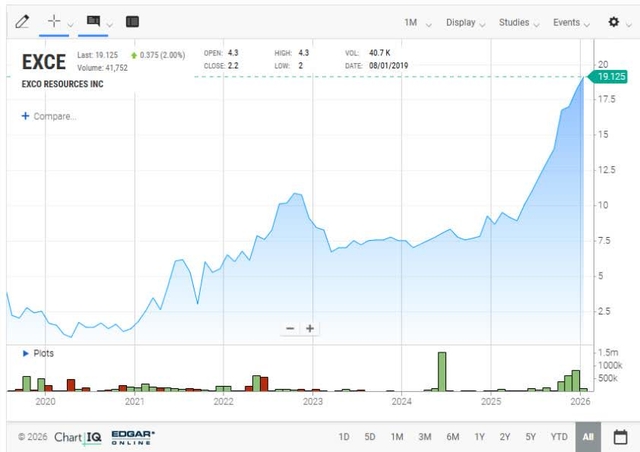
We don’t think you have to be an expert on future natural gas prices or well flow rates to like the setup. With production set to increase and having a proven track record of hedging successfully, we are quite optimistic. If natural gas goes to $2 per mcf, Exco is near breakeven, but will have about $4 per share in cash flow. Assuming a 10% increase in production and pricing of $3 per mcf we think they can earn about $3 per share (and have $7 per share in cash flow), and at $4 per mcf they would push $6 per share (and have total cash flow of about $10 per share) in comparison to its current $19 per share price. As we write this, current two year strip pricing averages about $3.75 per mcf. Hopefully we are underestimating their potential production increase.
Lastly as of the end of 2024 reserves were 28 times production. Admittedly, 75% of reserves were undeveloped, but that is still quite impressive. Their PV-10, which is the estimated present value of Exco’s future after tax cash flows discounted back at a 10% rate, was nearly $40 per share. Natural gas pricing outlook is more favorable today than it was at the end of 2024. Obviously, they would be an attractive acquisition candidate.
Performance Attribution
Last quarter we noted that we currently think of the fund as having three categories: expert market stocks, control positions (where the fund manager is on the board and can have greater influence over decision making), and generally undervalued securities.
Most of the fund’s performance in the fourth quarter was due to the increase in the valuation of our control position. It increased 14% in the quarter. Our expert market stocks increased in value by just under 3% in the fourth quarter, while our generally undervalued securities increased less than 1%.
Update on Our Control Position
As we noted above, by control, we mean that the fund manager is on the Board or in a position to significantly influence decision making, not that he has total control and gets what he wants. Solitron (SODI) has, and PharmChem had, a strong independent board, which is the way it should be at all companies.
Solitron Devices (SODI) (otc: SODI) – the bid price for shares increased from $16.40 per share to $18.69 per share during the fourth quarter. As a reminder, the fund manager is CEO and a board member of Solitron. The fund owns 11.2% of Solitron’s outstanding shares and the fund manager and his family own 3.0%.
Solitron’s earnings have been disappointing the last year and a half due to lower revenues owing to the timing of receipt of orders. Solitron started seeing a material uptick in orders (bookings) beginning in the November 2024 quarter. That quarter included a large order for HIMARS (High Mobility Artillery Rocket System) components from L3Harris (LHX) – Solitron’s second largest defense customer. In the fiscal fourth quarter ending February 28, 2025, bookings were $8.9 million, and included over $5 million from Solitron’s largest defense customer, RTX (formerly Raytheon (RTX)) for AMRAAM (Advanced Medium-Range Air-to-Air Missile) components. The May and August quarters bookings exceeded sales despite no orders related to HIMARS or AMRAAM. Solitron’s November 2025 bookings were its highest ever, at $13.9 million, which included the next AMRAAM order.
Sales in the November 2025 quarter reflect the higher backlog of the previous quarters. With a backlog of over $27 million, Solitron is well positioned to begin reporting improved revenue and earnings.
Due to being an insider we only restate what has been publicly released in our SEC filings or press releases. We also do not provide any valuation estimates for Solitron.
Update on Other Fund Holdings
ENDI Corp (ENDI) (otc: ENDI) – we profiled ENDI in our 2024 first quarter letter when the share price was around $6.50 per share. The share price declined during the fourth quarter from $17.55 per share to $16.75 per share. ENDI owns CrossingBridge Advisors (ENDI) which manages fixed income mutual funds and a few managed accounts. Assets under management (AUM) for CrossingBridge grew over 30% in 2024, from $2.6 billion at the beginning of 2024, adjusted for the acquisition of the RiverPark Short Term High Yield Fund, to $3.4 billion at the end of 2024. According to their website, as of the end of December 2025, AUM was in excess of $4.1 billion, an increase of over 19% in 2025, despite a modest decrease in Q4. While not a central component of our thesis, with short term rates falling, we think investors may move into the short-term bond category to gain higher yield than money markets.
ENDI’s reported earnings and operating margins do not reflect what is happening at the company. The first issue is the accounting treatment for the change in warrant liability. The company issued warrants as part of the CrossingBridge acquisition. Under accounting rules, the change in value is run through the income statement, such that when the company’s price increases they are hit with a charge, and vice versa. We think it is one of the dumber accounting rules since it makes earnings improve when their stock price decreases and decline when their stock price increases. Thankfully, right before yearend, ENDI reached an agreement for an early cashless exercise.
The second issue is amortization of purchased management contracts. ENDI purchased management contracts on some of the funds it advises for, which created intangible amortization. These are non-cash charges and only reflect reality if the value of the management contract was declining at the amortization rate, which is not the case. The value, in our opinion, is actually increasing. Regardless, it hurts operating income and reported earnings. The Company helps investors understand this by reporting adjusted operating margins and adjusted EBITDA. Adjusted operating margins are in excess of 50%, which is excellent.
A third issue, is the presence of non-controlling interest which is how accounting rules treat ENDI’s decision to sell 25% of CrossingBridge in 2025 for $25.9 million. The sale involved cash coming to the company in exchange for what is essentially a revenue royalty to the minority investors (Cbe Llc). The fund, and other entities affiliated with the fund manager, including Solitron, participated in the transaction. We think it is a win-win deal. It shows the value of CrossingBridge and provides additional capital to good capital allocators to grow assets under management. We discussed that transaction in our second quarter letter .
The end result is that we have to make a number of accounting adjustments to arrive at what we think is a clearer picture of true economic reality for ENDI. After the warrant exercise, ENDI has approximately 6.65 million shares outstanding, resulting in a market cap of ~$105 million. Cash and investments were $55 million as of September 2025, and the only debt was a $10 million note. Adjusted EBITDA was $3.1 million in the September quarter, or $12.5 million annualized. We expect them to introduce some additional products in the next year which should help AUM growth to continue. Our fair value estimate keeps rising as the company continues to execute, which is what you ideally want in all your equity investments. We look forward to what 2026 will bring.
Community Banks
We noted in our last letter that the fund has been building up a basket of what it sees as attractively priced community banks. At year end, 20% of the fund was in bank stocks. This included First IC mentioned above, which was just over 6% of the fund, as well as a few ECIP banks we re-entered into in Q4 as prices fell, Skyline Bankshares (SLBK) (otc: SLBK) which we profiled in our Q1 2025 letter, and the basket of smaller banks we have been building. The basket is mainly modestly growing community banks trading at less than six times earnings, which we believe should trade at higher valuations, and would be attractive acquisition candidates.
While the ECIP banks have underperformed in the recent year or so, we think they will screen better once they can repurchase the outstanding preferred stock at a deep discount. Some will be trading at half of book value and around six times earnings. If they do not make acquisitions or improve their valuations via increased dividends or share repurchases, they will likely become targets for acquisition.
Room for New Members and/or Additional Funds
We continue to have more attractive ideas than capital. Thus, there is plenty of room for existing partners to increase their investment and for others to join. Please consider referring friends of yours who may be potential new investors. The basic requirements are 1) that each invests a minimum of $100,000 and 2) that new members are accredited (high net worth) individuals. Subsequent investments must be for a minimum of $10,000.
If this letter was passed on to you and you would like to be added to our monthly distribution list, please email me at the email address below. You can find more letters at eriksencapitalmgmt.com/investor-letters . Should you have any questions regarding the fund, please don’t hesitate to call or email.
Sincerely,
Tim Eriksen, Manager, Cedar Creek Partners LLC
Original Post
Editor’s Note: The summary bullets for this article were chosen by Seeking Alpha editors.
Read the full article here